

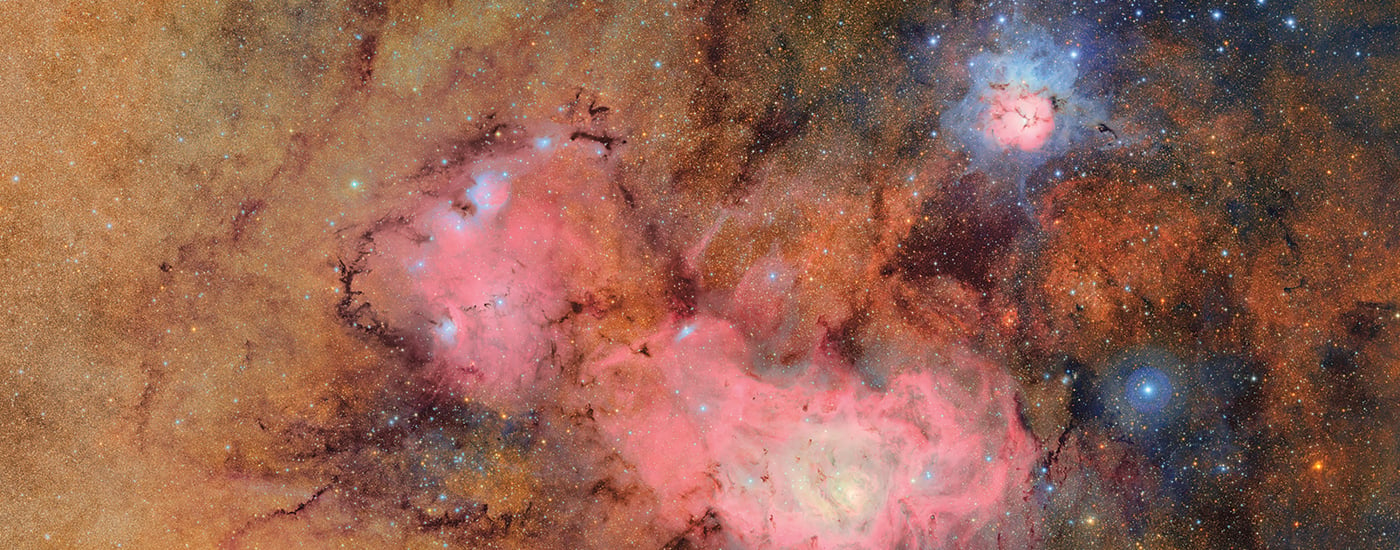

Pink & blue nebulae glow among dark dust lanes & dense star fields across a golden region of sky

This image, taken by the Vera C. Rubin Observatory, shows gases, dust, and other objects that are trillions of miles from Earth!

RubinObs/NOIRLab/SLAC/NSF/DOE/AURA

Standards

Into the Unknown

Scientists are taking stunning new photos of the farthest reaches of our universe.

This summer, scientists began filming a movie that’s sure to be out of this world! Every night for the next 10 years, a giant telescope will capture thousands of images of our solar system. The photos will show colorful clouds of gases, glowing  galaxies , and more.

Eventually, experts will combine the images into a time-lapse movie. The goal is to show how the universe is changing over time.

The incredible photos are being captured by the Vera C. Rubin Observatory. It sits high atop a mountain in Chile, a country in South America. The observatory’s  remote  location provides a clear view of the night sky.

Experts say the images could help scientists unlock some of the biggest mysteries of our universe.

What You Need to Know About the Universe
Watch a video about what’s beyond Earth.

Mapping the Sky

People have been studying space for thousands of years. But there’s still a lot we don’t know about it.

The observatory’s photos will help scientists learn more about everything that  orbits  our sun. That includes millions of space rocks, such as asteroids and comets (see “Rock Stars”). Some of them could be dangerous to life on Earth.

Olivier Bonin/SLAC National Accelerator Laboratory

The Vera C. Rubin Observatory sits at the top of a mountain in Chile.

Amazing Views

The observatory will snap about 1,000 images every night. A few of the photos have already been released to the public. Some show objects that are thousands of light-years from Earth. One light-year equals nearly 6 trillion miles. (That’s 6 followed by 12 zeros: 6,000,000,000,000!) But in the pictures, these objects look amazingly detailed. It’s all thanks to the observatory’s powerful telescope. It features the largest digital camera ever built. The camera weighs more than 6,500 pounds and is about the size of a small car.

The telescope is made up of huge mirrors. The largest is nearly 28 feet across—about the length of a typical elementaryschool classroom. The massive mirrors capture and focus light from space. That helps the telescope’s camera snap clear photos of faraway objects.

More to Explore

Scientists all over the world are already buzzing about what the project may reveal. Michaela Musilova is one of them. She studies the possibility of life in space.

“It will really help us to get a better idea of what else is out there,” Musilova says.

videos (1)
Skills Sheets (2)
Skills Sheets (2)
TEACHER SUPPORT (2)
TEACHER SUPPORT (2)
Text-to-Speech